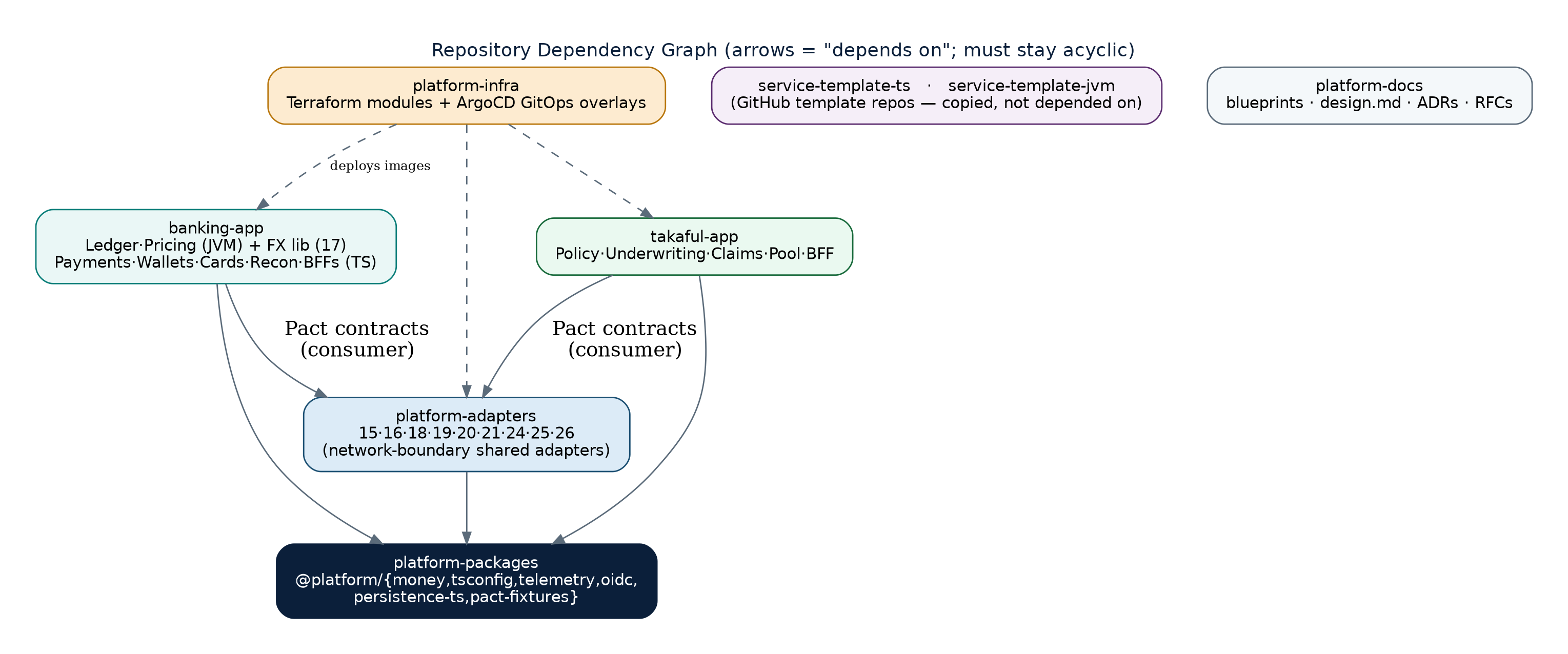
Eight repositories, one direction of dependency
platform-packages sits at the root; everything depends downward onto it. The two apps depend on platform-packages and on platform-adapters (contract-verified via Pact) \u2014 never the reverse.
- Three placements are counter-intuitive by design: the FX library lives inside
banking-app, not the adapters repo; OIDC ships as a client package; Persistence is dual-language. - The shared adapters live in one workspace but version and deploy independently, per adapter.
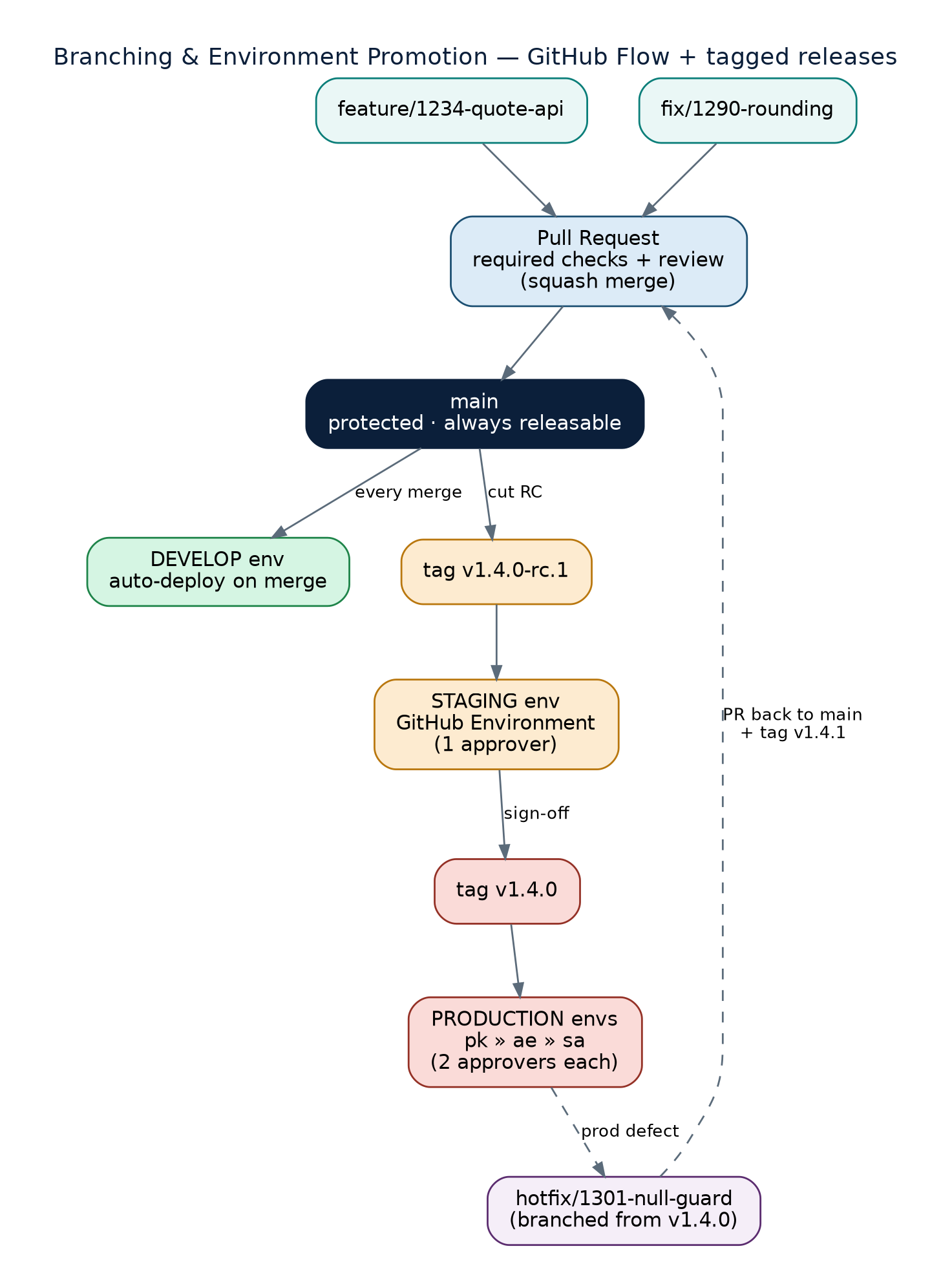
Trunk-based, promoted by tag \u2014 not by branch
Short-lived feature branches merge to a protected main. Environments are fed by promoting the exact same signed artifact through tags and approvals: develop auto-deploys, staging needs one approval, production needs two \u2014 per region.
- No long-lived
developbranch \u2014 environments are a deployment concern, not a branching one. - Hotfixes branch from the production tag and reconcile back to main the same day.
A float or rounding error in the ledger or a quote is catastrophic \u2014 exact BigDecimal arithmetic and JVM throughput justify leaving the TypeScript default in exactly these three places.
One language by default, two by exception
Every shared adapter, every domain service and every BFF is NestJS/TypeScript. The exception is drawn as narrowly as possible: Ledger, Pricing and the in-process FX library \u2014 nothing else.
- Three guardrails compensate for leaving the JVM elsewhere: integer minor-unit money (
@platform/money), dependency-cruiser boundary tests, and strict TypeScript config. - Every TS \u2194 Java seam is locked by Pact contracts in CI.